ExperiencesSafari experience
Great Migration
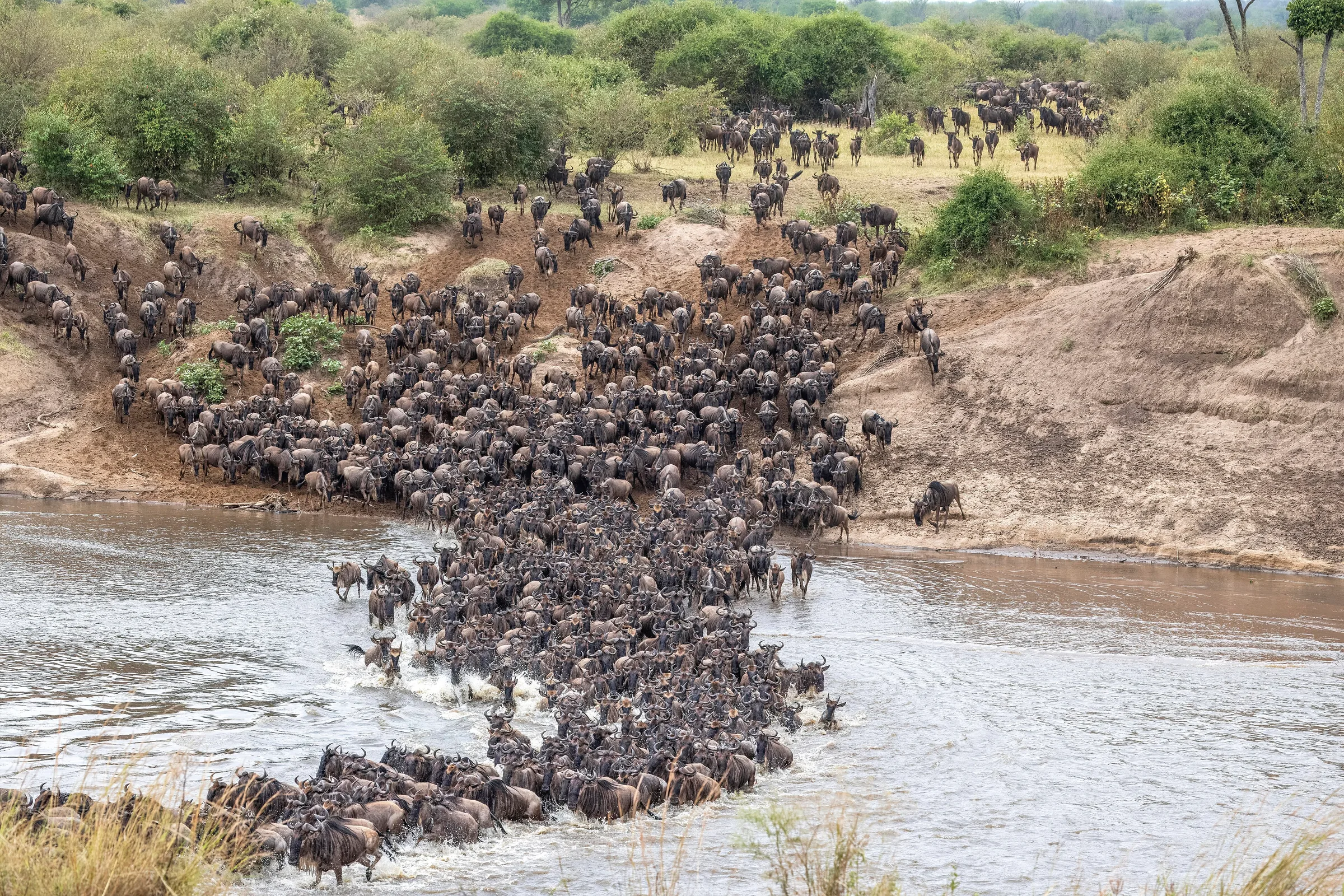
On the Mara, a whole river bank can hesitate for an hour, then go.
- From
- $1,030 per person
- Per person sharing. Lodging + park fees at low-season rates across a core itinerary, plus baseline drive transport. Excludes international flights and activities.
- Best months
- Jun, Jul, Aug, Sep, Oct

About
About this experience.
The first sign is usually dust. A long smudge on the horizon above Kogatende, then the sound, a low and continuous grunting that carries further than you expect. By the time the column reaches the Mara River the front animals have often stopped dead at the lip of the bank, pressed forward by the thousands behind them. Some days nothing happens and the herd drifts back to graze. Other days a single zebra drops down the bank and the whole line follows, and for ten minutes or forty the river is a churn of bodies, spray and crocodiles.
This is the northern Serengeti between July and October, and it is only one chapter of a year-round circuit. Well over a million wildebeest, with roughly a quarter of a million zebra and hundreds of thousands of gazelle, move in a great loop through the Serengeti and Kenya's Maasai Mara. They calve on the southern short grass plains from January to March, drift north west through the Western Corridor around May and June, where the Grumeti River gives the first crossings, and reach the Mara from July. UNESCO notes that the Mara is the only river flowing through the park all year, which is precisely why the herds must keep coming back to it. It rises on Kenya's Mau Escarpment and runs about 395 kilometres to Lake Victoria.
What it is really like: early starts, long waits and a lot of guiding judgement. Kogatende and the Lamai area across the river are the two Tanzanian bases, and guides here know the favoured crossing points by habit, but no one can tell you which one a herd will choose or when. A crossing can be spectacular and brutal. Research led by the Cary Institute found that on the Kenyan stretch of the Mara an average of about 6,250 wildebeest drown each year, mass drownings recorded in 13 of the 15 years studied, and that those carcasses feed the river for years. Crocodiles take only a small share. It is not a gentle scene, and it is worth knowing that before you go.
The honest caveats. Timing shifts with the rain, so a "July crossing" can mean late July in a dry year. Crossings can cluster, with several in a morning and then a quiet three days. Popular points draw vehicles, although park rules and good guides keep a respectful distance. If you have only two nights in the north, you are relying on luck; four nights gives the herds time to make up their minds. And the migration is not the whole Serengeti: lions, cheetah and leopard stay put all year, so a quiet river day is rarely a wasted one.
Where you sleep matters more than anything else. We place guests in camps close to the river, such as Nimali Mara on its kopje about ten minutes from the crossings, Ole Serai Luxury Camp at Kogatende a couple of kilometres back from the water, or Heritage Mara Migration Camp, which only operates during the crossing season. For the Grumeti chapter in May and June, we use the Western Corridor and the Ikoma side, at camps such as Mbalageti Serengeti or Grumeti Hills. On your quote every element is separate: Serengeti conservation fees per person per 24 hours, each camp's nightly rate, the flights or road transfers between areas, and any extras such as a balloon. You see why a crossing safari costs what it does.
It suits travellers who are patient, comfortable with early mornings and happy to sit by a river for hours on the strength of a probability. Photographers and second-time visitors tend to love it. If you would rather see vast numbers without the drama, consider the calving season at Ndutu instead.
How to structure it
Building it into your trip.
For the Mara crossings, plan four nights in the north between mid July and October, ideally split two and two between Kogatende and a second camp so your guide can follow the herds. Fly from Arusha to the northern airstrips rather than driving, which takes most of a day each way. Add two or three nights in the central Serengeti around Seronera beforehand, where big cat sightings are reliable year-round. For May and June, swap the north for the Western Corridor and the Grumeti. Finish with four or five nights on Zanzibar's north or east coast, flying direct from the Serengeti airstrips.
Best time to go
When to go.
- January: not a best month
- February: not a best month
- March: not a best month
- April: not a best month
- May: not a best month
- June: best
- July: best
- August: best
- September: best
- October: best
- November: not a best month
- December: not a best month
Best months: June to October.
Gallery
A closer look.
Photo credits
- 02Photo: Charles J. Sharp, CC BY-SA 4.0, via Wikimedia Commons
- 03Photo: Charles J. Sharp, CC BY-SA 4.0, via Wikimedia Commons
- 04Photo: Charles J. Sharp, CC BY-SA 4.0, via Wikimedia Commons
- 05Photo: Charles J. Sharp, CC BY-SA 4.0, via Wikimedia Commons
- 06Photo: Wolves201, CC BY-SA 4.0, via Wikimedia Commons
- 07Photo: Christoph Strässler, CC BY-SA 2.0, via Wikimedia Commons
- 08Photo: Richard Mortel from Riyadh, Saudi Arabia, CC BY 2.0, via Wikimedia Commons

Common questions
Questions, answered.
When is the best time to see a Mara River crossing?
Crossings on the Tanzanian side usually run from July to October, centred on Kogatende and Lamai in the northern Serengeti. The exact timing depends on the rains, so we plan the core of your stay for August or September where possible and allow at least four nights in the north. Earlier in the year, May and June, the Grumeti River in the Western Corridor sees the first crossings, which are usually smaller but often quieter.
How many nights do I need to have a good chance of seeing a crossing?
We recommend four nights in the north. Herds can gather on a bank and turn back several times before committing, and crossings tend to cluster. With two nights you are hoping for a lucky morning. With four, your guide has room to wait at the right place and still enjoy the lions, elephants and cheetahs that live in the north year-round. Nothing in the wild is certain, but the odds are good.
What makes a migration safari more expensive than other safaris?
Three things: seasonal camp rates in July to October, flights to the northern airstrips, and Serengeti conservation fees, charged per person for every 24 hours inside the park. On your quote each of those appears as its own line, alongside each camp's nightly rate, so you can see exactly where the money goes and where a different camp or one fewer night would change the total.
Is a river crossing upsetting to watch?
It can be. Animals are injured, some drown and Nile crocodiles hunt at the crossing points. Studies of the Mara in Kenya recorded thousands of drownings a year, which in turn feed the river's fish and scavengers. Most guests find it extraordinary rather than distressing, but if you are travelling with younger children it is worth talking it through with your Expert first.
Can I combine the migration with a beach stay on Zanzibar?
Yes, and it is the most popular way to do it. Light aircraft fly from the Serengeti airstrips to Zanzibar, so you can go straight from the river to the coast without returning to Arusha. July to October is also one of Zanzibar's driest periods. We show the safari, the flight and the beach nights as separate lines so you can adjust the balance.
Will I see the herds if I travel outside the crossing season?
Very likely, just in a different place. The wildebeest are somewhere in the Serengeti ecosystem all year: on the Ndutu plains for calving from January to March, moving through the centre and west around April to June, and returning south in November and December. We plan your camps around where the herds typically are in your month, rather than selling one fixed route.
Build your trip
Plan a great migration trip.
Tell us when you can travel and what you most want to see. We'll build a custom itinerary around Great Migration with transparent pricing throughout.
Build & price your trip