
Single
One of the sixteen tents taken by a single guest, with gauze windows, a seating area, a private bathroom with flush toilet and bucket shower, and a terrace.
Lodges & partnersSeronera Central Serengeti
Sixteen canvas tents in the Banagi Valley, north of Seronera and away from the circuit.
From $124 per person per night
About
Ronjo Camp stands in a wooded glade in the Banagi Valley, inside Serengeti National Park and about fifteen kilometres north of the Seronera valley. That distance is the whole point. Seronera is where most central Serengeti vehicles start and finish the day, and Ronjo sits north of it, between two lines of wooded hills, with acacias around the tents and the plains and the Banagi hills in front of them. Retima hippo pool, where the Seronera and Grumeti rivers meet, is in the same reach of valley.
The central Serengeti is the one zone that works in all twelve months, because the game here is resident rather than migratory. The riverine sausage trees and umbrella thorns along the Seronera hold one of the densest leopard populations in Africa, lion live on the kopjes and along the river, and cheetah hunt the open ground to the south. The migration passes through rather than settles: January and February put the herds on the southern and central plains ahead of calving, June and July take them west toward the Grumeti, and August to October they are far north on the Mara river, a long day away. November and December bring them back south through this country.
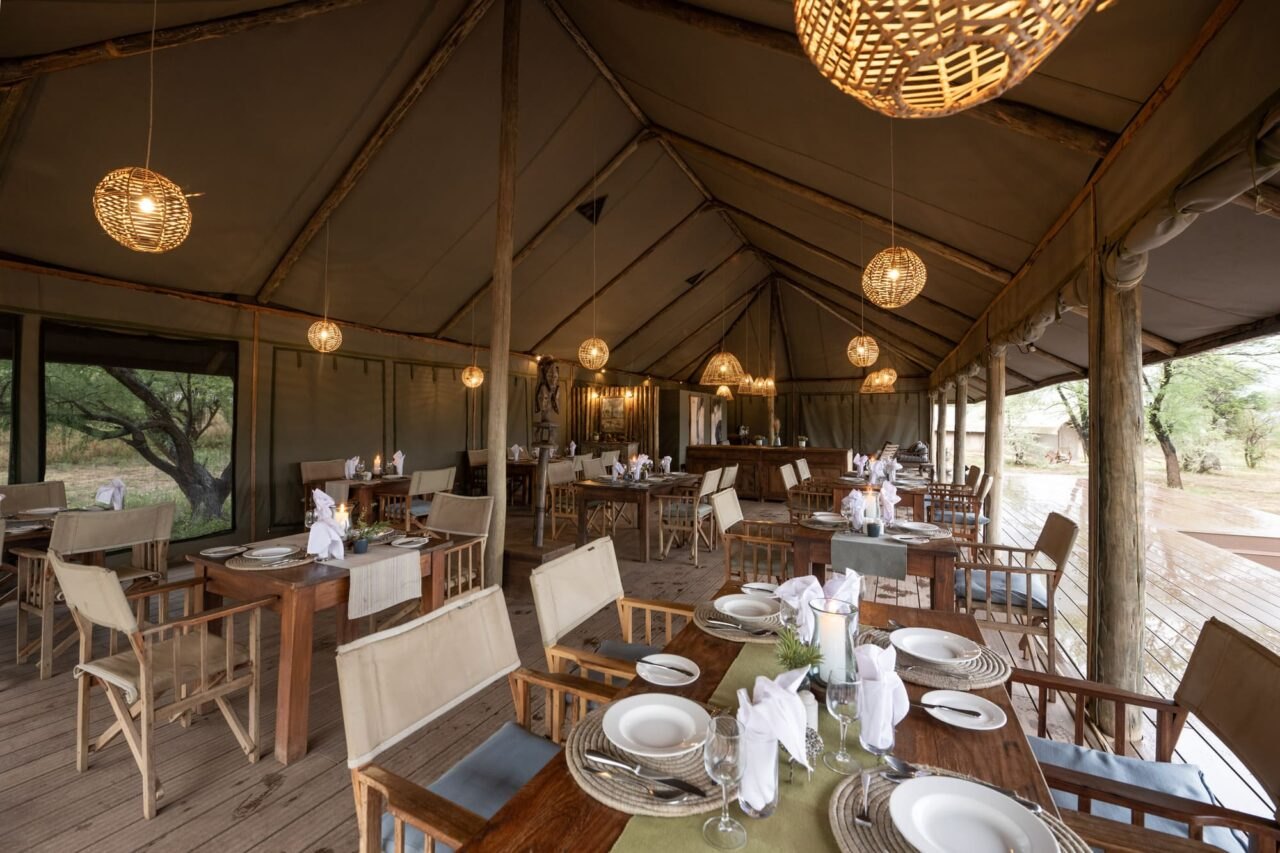
The camp is deliberately old fashioned. Sixteen tents of twenty four square metres with gauze windows, a comfortable bed, a seating area with armchairs, a private bathroom with a flush toilet and a bucket shower, and a terrace. Hot water is carried to the tent at a time you book. Power is a ten kilowatt solar installation with charging points in the mess rather than in the tents, so the lighting is low and the evening is lit by lantern and by fire. Two large canvas mess tents hold the lounge and the dining, and there are open fire pits outside.
It suits people who wanted a safari camp rather than a hotel under canvas. The camp is unfenced and animals move through it: guests regularly report lion and hyena close by at night, and Maasai guards walk you to and from your tent after dark. Guests who expect plumbed hot water, reliable connectivity and bright lighting are the ones who leave disappointed, and we would rather say so in advance. Everyone else tends to comment on the staff, who come up in review after review.
By road the camp is a full day and more from Kilimanjaro International, roughly nine to ten hours of driving through Arusha, the Ngorongoro highlands and Naabi Hill gate, which is normally broken with a night in Karatu or on the crater rim. Flying is the sensible option: Seronera airstrip is sixty five to ninety minutes from Arusha Airport depending on the stops, and the camp lies about fifteen kilometres north of it on park track.
Signature experiences
A morning working the river line south of camp, through the sausage trees and umbrella thorns that hold one of the densest leopard populations anywhere in Africa.
Where the Seronera and Grumeti rivers meet, in the same reach of valley as the camp. Dozens of hippo in one bend, and one of the few places in the park you are allowed out of the vehicle.
A pre dawn transfer and an hour or so aloft as the light comes up over the central Serengeti, ending with a full breakfast laid out in the open.
Maasai, Boma and Simba kopjes stand out of the grass south and east of Seronera, and they hold lion and cheetah. They also give the plains their scale, which photographs never quite manage.
Dinner by lantern in the mess and then the fire pit outside, with the camp unfenced around you and the escort waiting to walk you back.
Gallery
Room types
One of the sixteen tents taken by a single guest, with gauze windows, a seating area, a private bathroom with flush toilet and bucket shower, and a terrace.
A canvas tent of twenty four square metres with one bed, gauze windows, armchairs, a private bathroom with flush toilet and bucket shower, and a terrace facing the plains.
The same tent as the Double, made up with two separate beds.
At a glance
Best time to visit
Best months: June to February.
Location & access
Seronera Central Serengeti
About three hours: road to Arusha Airport, sixty five to ninety minutes by light aircraft to Seronera airstrip depending on the stops, then about fifteen kilometres north by game drive vehicle.
About nine to ten hours of driving: one hour to Arusha, then roughly eight hours through Mto wa Mbu, the Ngorongoro highlands and Naabi Hill gate to Seronera, then about fifteen kilometres north on park track. This is normally split over two days with a night in Karatu or on the crater rim.
On the map
2.342° S, 34.846° E
What's included
Frequently asked
Sixteen, each of twenty four square metres, arranged in an arc around two canvas mess tents. The camp publishes no separate room categories, so every tent is the same product with the bed made up to suit.
Inside Serengeti National Park, in the Banagi Valley about fifteen kilometres north of the Seronera valley. Retima hippo pool, at the meeting of the Seronera and Grumeti rivers, is in the same stretch of country.
Flying is the sensible option: sixty five to ninety minutes from Arusha Airport to Seronera airstrip, then about fifteen kilometres north on park track. Driving from Kilimanjaro International is nine to ten hours and is normally split over two days.
Each tent has a private bathroom with a flush toilet, a washbasin and a bucket shower. You book a time and hot water is carried to the tent. There is no plumbed hot water anywhere in the camp.
No. Animals move through it at night, and guests regularly hear lion and hyena close by. Maasai guards escort you between your tent and the mess after dark, and each tent has an emergency call button.
Children are welcome, though there is no family tent and no childrens programme. Given the unfenced camp and the walk to the mess after dark, it suits children old enough to follow an escort without fuss. Children cannot be booked into a tent of their own here.
Full board with three meals a day, plus VAT and service charge. Drinks, park fees and the Tourism Development Levy are charged separately.
Any month works, because the central Serengeti game is resident. January and February put the migration on the plains south of here, June and July take it west, and August to October it is far north on the Mara river, a long day away.
Yes. From 1 October 2026 visitors entering mainland Tanzania must hold the government inbound travel insurance, 44 USD per adult and valid for up to 92 days, covering emergency medical care, evacuation, repatriation and lost luggage. Children aged 3 to 17 pay half and infants under 3 are free. It is bought online before you fly or on arrival, and residents of Tanzania and of East African and SADC countries are exempt. If you land in Zanzibar first, the Zanzibar policy covers you instead. It is paid by you directly and is not part of our quote.
What's nearby
in the same reach of valley
The confluence of the Seronera and Grumeti rivers, packed with hippo, and one of the few places in the park you may leave the vehicle.
about fifteen kilometres south
A small museum and an interpretive trail around a kopje, with staff who will tell you where the cats were this morning.
about fifteen kilometres south, then work the river
The classic central Serengeti drive for leopard and lion, best in the first and last hours of light.
south west of Seronera, a long morning
The quietest of the kopje country, good for lion and cheetah and for the rock paintings.
about two and a half hours south
The classic vantage over the southern short grass plains, at its best from January to April.
about three and a half hours
A full day out, or more sensibly the next stop on a southbound itinerary rather than a day trip.
Plan this stay
Build your bespoke Tanzania safari with our team. Real lodge rates and itemised pricing throughout.
Build & price your trip
