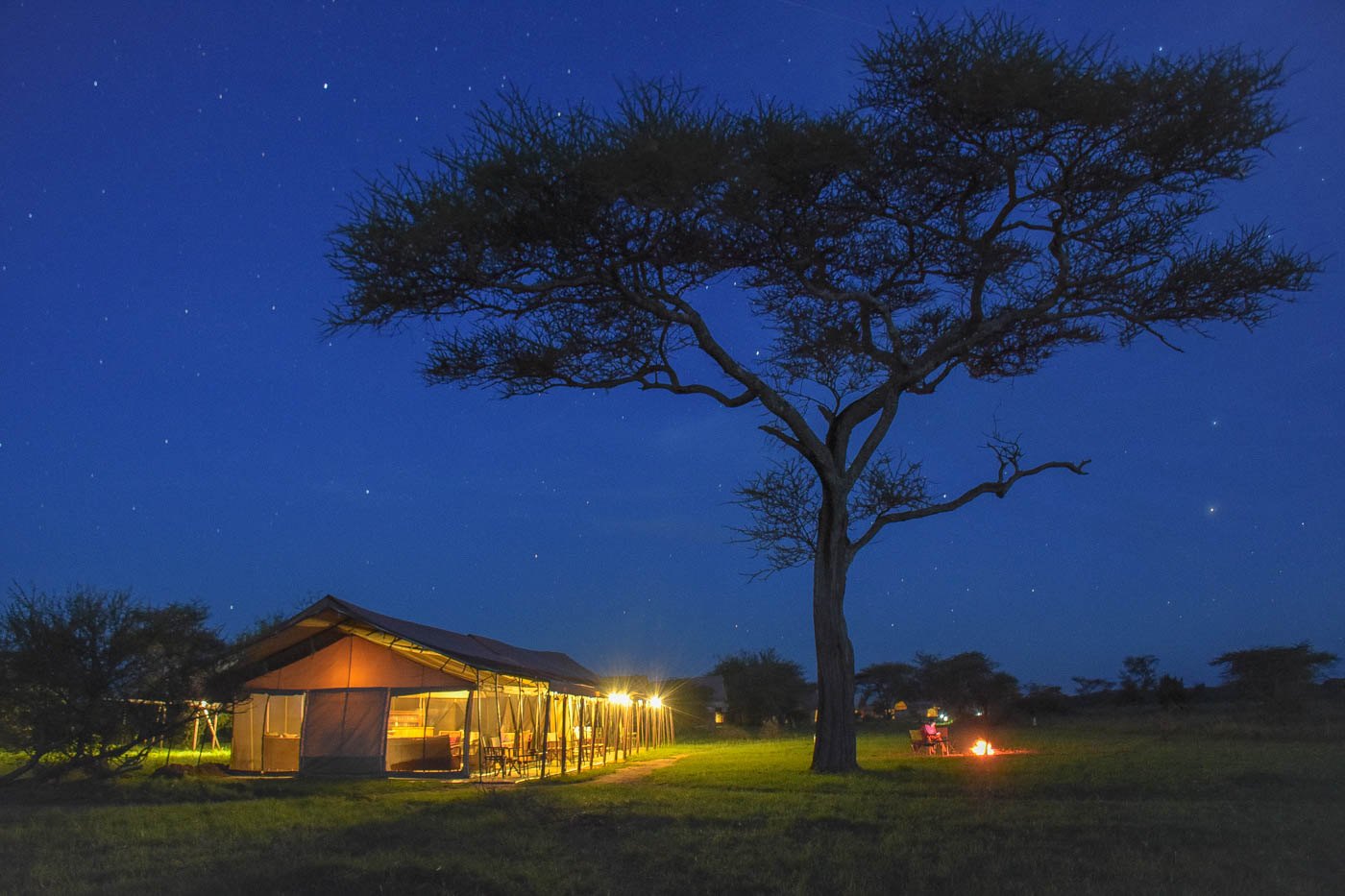
Where exactly is Thorn Tree Camp?+
On open grassland in the Seronera Valley in the central Serengeti, about fifteen minutes from the Seronera airstrip and the visitor centre, looking out towards Banagi Hill.
How many tents does the camp have?+
Ten, each about ten metres by four and a half with an extended sitting area and a shaded veranda. Every tent has its own bathroom with a flush toilet and a shower with running hot and cold water.
When is the camp open?+
All year. The Seronera river holds water through the dry months, so resident game stays in the area in every season and the camp does not close.
How do guests reach the camp?+
Most fly. Seronera is about forty five minutes to an hour from Arusha Airport on the light aircraft services, then only about fifteen minutes by road to camp. By road from Arusha it is a long day, roughly seven hours through Ngorongoro and across the plains, and most people break it with a night on the way.
What is included in the rate?+
Full board, so breakfast, lunch and dinner, with tea, coffee and bottled water at meals, plus the Tourism Development Levy and VAT. Park entry and conservation fees, the special campsite fee, game drives, transfers, other drinks and gratuities are all settled separately.
Are families with children welcome?+
Yes, and the camp prices a triple. Note that the contract requires children below thirteen to share a tent with an adult, so a child cannot take a tent alone here.
Is the camp fenced?+
No. It sits unfenced on open grassland and wildlife moves through, which is part of the appeal. Guests are escorted to and from the dining tent after dark.
Is there wifi, power and laundry?+
There is wifi, best in and around the dining tent rather than in the tents. The camp runs entirely on solar, including the lighting and the hot water. There is no laundry service.
Is there a swimming pool?+
No. Thorn Tree is a canvas camp inside the park with no pool and no spa. The public areas are a dining tent, a lounge tent and a campfire on the grass.
What is the best time to visit?+
Game viewing is good in every month because the resident population does not disperse, which is the point of this camp. June to October is the easiest, with short grass and animals on the water. The migration passes through around May and June going north and November and December going south. The calving herds in January to March are on the southern plains near Ndutu, a long drive away, so this is not the base for calving.
What time is check in?+
From midday, with check out at ten in the morning.
What are meals like?+
Full board. Breakfast and dinner are served in the dining tent, and a lunch box goes out with guests on the long game drive days. Special diets are catered for with notice.